Generic selectors
Exact matches only
Search in title
Search in content
Post Type Selectors

Dubai Trip Cost from India: Complete Travel Budget

Planning your first trip to Dubai from India is like filling out an unknown spreadsheet before the trip. However, during itinerary planning, you cover things like flights, accommodations, and activities. The budget feels friendly enough until things start adding up—visa, desert safari, Burj Khalifa ticket, airport taxis, and unplanned expenses like dinners out.

In the end, the total budget does not just creep up; it jumps. This isn’t someone’s mistake; it’s a budget gap. That’s the usual story with the Dubai trip cost from India.

The headline prices that you see online are not all-inclusive; do not fall into the trap. Instead, look for a realistic Dubai travel budget with every detail written down. Also, the price may change over the season. So, instead of a confident figure to satisfy your eyes, we think you need to have an idea of the price ranges for the whole trip.

How Much Does a Dubai Trip Cost from India?

A Dubai trip from India for a five-day budget trip will cost around ₹50,000 to ₹80,000 per person. A mid-range to Luxury holiday package, with a 4-star hotel, will range from ₹96,000 to ₹1,75,500 per person. This comes down to roughly ₹3,00,000 to ₹5,00,000 in total for a four-member family trip to Dubai. 

Approximate costs of Essential Travel Expenses for a Dubai Trip from India

Main Expenses Comfortable Trip Budget Trip Premium Trip
Dubai Visa AED 200 (~₹4,700 to ₹4,800 + 5% VAT),

AED 302 (₹7,699)

AED 200 (~₹4,700 to ₹4,800 + 5% VAT),

AED 302 (₹7,699)

AED 200 (~₹4,700 to ₹4,800 + 5% VAT),

AED 302 (₹7,699)

Hotel – 4 nights AED 1200- 2300 (₹32,000 to ₹60,000) – 4 star AED 500 – 700 (₹12,800 to ₹18,000) – 2-3 Star AED 3700 – 10000 (₹96,000 to ₹2,60,000) – 4 Star
Return flight AED 1,650–2,000 (₹40,000–48,000) AED 700–1,400 (₹18,000–35,000) AED 2,000+ (₹48,000+)
Food AED 380–685 (₹10,000–₹18,000) AED 190–305 (₹5,000–₹8,000) AED 950+ (₹25,000+)
Sightseeing AED 455–760 (₹12,000–₹20,000) AED 190–380 (₹5,000–₹10,000) AED 950+ (₹25,000+)
Local Transport AED 150–267 (₹3,800–₹6,800) AED 75–150 (₹2,000–₹4,000) AED 380+ (₹10,000+)
Miscellaneous AED 190–380 (₹4,800–₹9,500) AED 115–190 (₹2,900–₹4,800) AED 570+ (₹14,500+)
Approx. Total AED 4225 – 6695 (₹1,07,000 – 1,70,000) AED 2480 – 3630 (₹63000-92000) AED 7800 + (1,98,000)


What you see online in the ₹40,000s comes with some serious compromises like shared rooms, only free sightseeing, and cheaper flights. And meals? No one can guarantee!

Couples get a small break, since a room costs the same with one person in it or two. Solo travellers feel it most. Pay for the whole room alone, and the Dubai holiday cost per head climbs noticeably, which is why a solo trip rarely costs half of what a couple spends.

While most people stay worried about flight fares and visa costs, Dubai trip cost from India mainly shifts dramatically based on your trip length. Flight and visa fares will remain almost the same during your trip dates, but the more days you spend there, the more you pay for accommodation, travel, and food. Five or six nights are the best choice for a first-time Dubai trip. However, we recommend six nights if you include Abu Dhabi on your Dubai trip.

What is the Dubai holiday cost for a couple or a family of four?

A couple can double the per-person figures, so a mid-range five-night trip comes to about ₹1,90,000 to ₹3,20,000 together. A family of four should plan on around ₹3,00,000 to ₹5,00,000 for the same plan. The cost per head is lower for families because rooms and airport transfers are shared. Attraction tickets are the exception, since child prices are often only a little below adult ones.

Where the Money Actually Goes

For first-time visitors, Dubai is a mystery, especially when it comes to budget allocation. They get confused about what the right Dubai travel budget is to save or invest on their trip. Here are the main expenses you’ll incur.
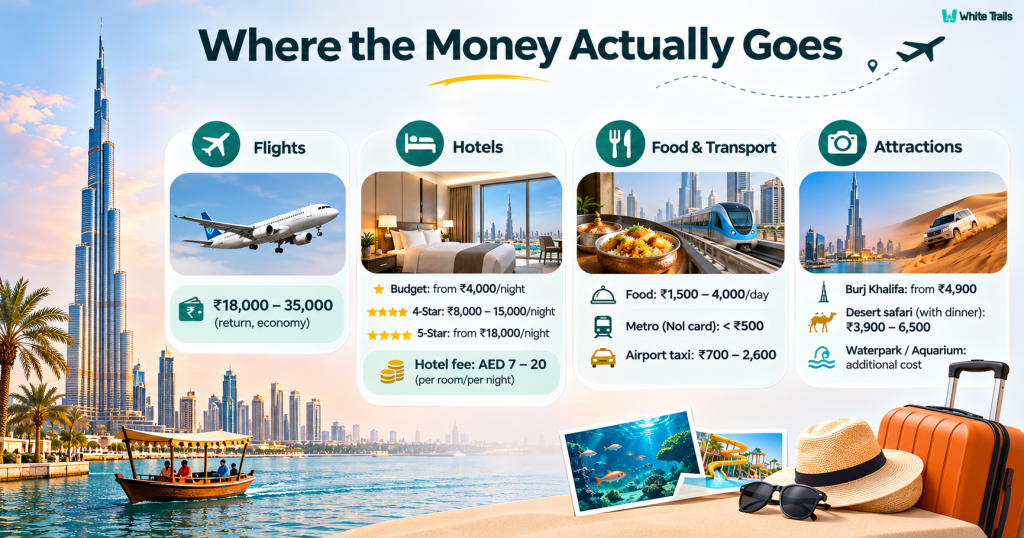
Dubai trip cost from India showing flight, hotel, food, transport and attraction expenses.

Flights

Flights are the biggest headache for many, in terms of price and booking as well. Though you will not face any availability issues, the price will vary based on factors like weekends and holidays.

However, return economy flights to any Indian metro city will cost around ₹18,000–35,000. But this price can push beyond ₹40,000 in festive weeks and the December school break. So, keep the season in mind and book early.

Hotels and the Fee at Checkout

Hotels swing more than any other line in a Dubai trip expenses sheet. Budget rooms in Deira and Bur Dubai start around ₹4,000 a night, while a decent 4-star usually runs ₹8,000 to ₹15,000. Five-star properties begin near ₹18,000 and climb fast.

Location matters as much as the stars. The same standard of room costs noticeably less in older Dubai than in Downtown or the Marina, and the metro makes those older districts easy to live in. You trade a skyline view for real savings.

Also, one thing most people miss out on: checkout dirhams from hotels. It will roughly cost around AED 7 to 20 per room per night, based on the hotel star rating.

Food and Getting Around

To be honest, this has no clear budget. It depends on the people, their habits, preferences, and willingness. Eating in Dubai does not take a big budget. Also, Indian food is readily available.

Plan to keep around ₹1,500 to ₹4,000 per day for food.

The cafeterias in Karama, Deira, and Bur Dubai serve budget-friendly meals to visitors. Also, vegetarian food is easy to find in Dubai. Many people plan for mall food courts during their mall visits based on their itinerary. However, brunches and rooftop dinners are where the money flows.

In terms of transportation, Dubai is quite convenient and budget-friendly. The metro covers almost all the places you visit, and with a Nol card you can keep the cost under ₹500 easily. However, taxi fare from the airport will cost you more. Roughly around ₹ 700- ₹ 2,600, based on your location and distance.

Attractions

This is where two travellers in the same hotel end up with very different totals. Burj Khalifa tickets start around ₹4,900 for a daytime slot, and sunset slots cost more. A shared evening desert safari with dinner usually falls between ₹3,900 and ₹6,500. Add a waterpark or an aquarium day and the list grows fast.

Pick two or three headline experiences and let the rest be free. The creek, the souks, the beaches and old Dubai’s lanes cost almost nothing. With children, it gets trickier, since child tickets are often only a little cheaper than adult ones.

Dubai Tour Package from India or DIY?

Now the real question is whether you should book a Dubai tour package from India or plan everything yourself. The best thing you can do is DIY your Dubai trip. But practically, that will take too much of your time and budget as well.

You have no idea about the places in Dubai, how the hotel works, where the food is good and what sort of activities come with hidden charges. Yes, you can get information from YouTubers and so on, but is it completely trustworthy? The decision is yours.

Also, budget is something that you need to consider when visiting abroad, whether solo or with partners, families or friends. Is a package actually cheaper? Yes, it is!

A Dubai tour package from India will combine flights, hotels, breakfasts, attractions and airport transportation. You can also choose from or customise your itinerary based on your preferences from tour operators like White Trails. It starts from just ₹58,500 for four nights, with flights, a 4-star hotel, breakfast and transfers. The longer eight-night Dubai and Abu Dhabi combinations start from ₹1,65,500. However, prices move with travel dates, so request a quote before you plan around any of them.
Package Enquiry Form

There’s a fair case for doing the opposite, though. A confident couple with flexible dates can often undercut a package on a short stay, using a budget airline and a Deira hotel. You also set your own pace. What you give up is –

  • Time
  • The safety net if a flight changes
  • Budget

Before comparing any two quotes, ask a few things.

  • Is the price per person or for two?
  • Is the visa included?

Then check which attractions are really in the itinerary and which are paid extras, and find out where the hotel sits. A cheap quote with a hotel far from everything often costs more once you add taxis.

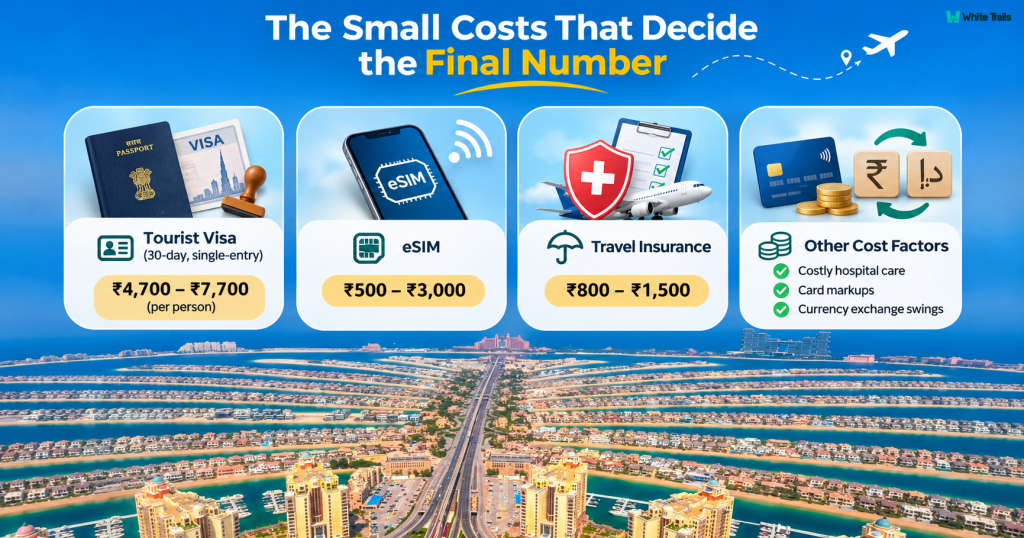
The Small Costs That Decide the Final Number

First-timers mostly underestimate the visa process. Indian passport holders need a tourist visa to fly to the Emirates.
Travel Expenses Breakdown – Dubai Trip Cost Guide

Check out the UAE government portal to understand how entry permits in Dubai work for Indians. You will get a 30-day single-entry visa at around ₹4,700 to ₹7,700 (per person). This price will vary depending on who processes it for you.

Apart from that, a tourist eSIM and travel insurance can add up a lot to your Dubai trip expenses.

  •  eSIM: ₹500-₹3000
  • Travel insurance (₹800 to ₹1,500)

Hospital care in Dubai is expensive and billed upfront. Card markups on foreign spending also nibble away at the total, and because prices are in dirhams while you earn in rupees, a small currency swing can shift a family budget by thousands.

Do Indians need a visa for Dubai, and what does it cost?

Most Indian passport holders need a tourist visa before they fly. A few can get visa on arrival if they hold a qualifying visa or residence permit from certain other countries, but those rules shift. Confirm with your airline or the UAE government portal first. A 30-day single-entry visa costs about ₹4,700 to ₹7,700 per person, depending on who processes it, and every traveller needs one, children and infants included.

Bringing the Dubai Travel Budget Down

Season does most of the work. November to March is the pleasant stretch, with mild weather and a busy events calendar, and it’s priced that way. June to August is cheapest, though the heat is heavy and afternoons mean staying indoors. October and April sit in between and deserve a look.

A few other choices matter too, roughly in order of impact.

  • Pick the district before the hotel. Older Dubai can cut the room bill sharply.
  • Move the Burj Khalifa visit away from sunset.
  • Book flights early for peak weeks.
  • Skip the second waterpark.
  • Check whether breakfast is included, because it quietly covers one meal a day for every traveller.
  • Hold back 10 to 15 per cent for things nobody planned, because every Dubai trip has a few.

Can I do a Dubai trip for under ₹50,000?

It’s possible, but tight. You’d need off-peak dates, a low-cost airline, a shared room in Deira or Bur Dubai, cafeteria meals and mostly free sightseeing. One headline attraction fits. Add a second and a waterpark day, and the number slips away quickly. White Trails offers the best budget-friendly Dubai package at ₹58,500, including 4 nights, a 4-star hotel, breakfast, and airport transfers.

Setting Your Budget Before You Book

We all end up with a little more in expenses than expected after every trip. But we do it willingly with planning or at least rough estimation. You know you can afford to spend that, so you pay more.

But people who overspend in Dubai rarely do it on one big thing. They do it on ten small ones they never count before the trip ends.

You can already estimate a sensible Dubai trip cost from India. Now what you need to do is not build a sheet or use budget allocation apps and enter all expenses, including the small ones.

Also, if you are rigid with the dates that you prefer, the budget has to bend somewhere else. Check all the figures against your current quote. Contact us to get the best possible visibility of your next Dubai trip cost from India.
Best Time to Visit Dubai: Weather, Seasons & Travel Tips

There is a huge difference between planning a proper trip to Dubai and booking a sudden flight to Dubai in July to skip the fare.

Think about it! You booked a flight to Dubai and landed there in July. The moment you stepped out of the terminal, the air felt like coming out of an oven. The next morning you had a plan to walk along the Marina, but you gave up after fifteen minutes. The rest: you and your partner spent the whole trip mostly within the malls and hotel pool.

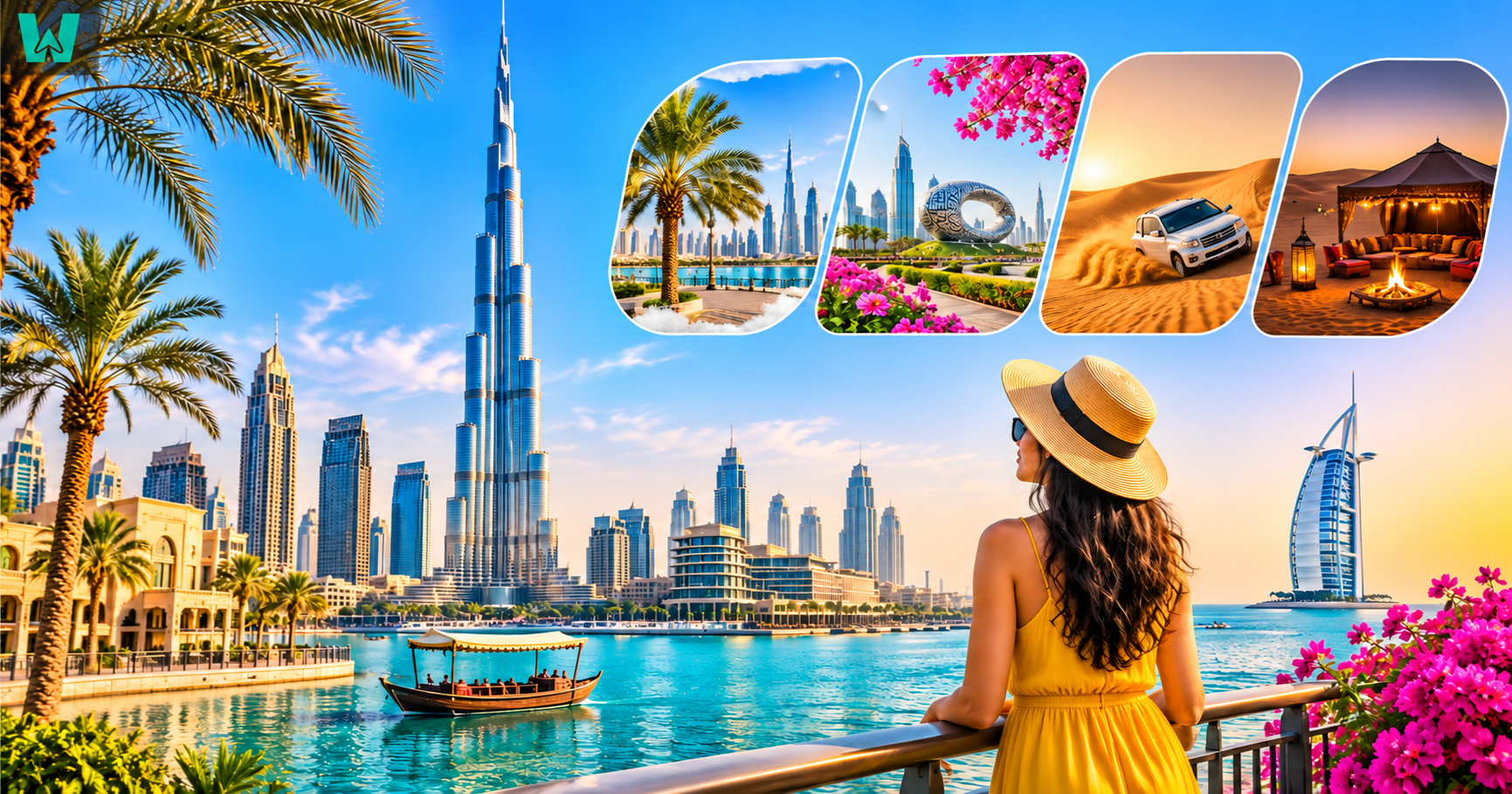
This sort of trip isn’t bad, but it isn’t fulfilling either. The best time to experience Dubai is between November and March.

Dubai is built for the cold season and tolerates the hot one. The skyline, the beaches, the desert, the outdoor markets — all of it feels exciting when the weather cooperates.

So let’s work out when that is, and when the trade-offs of going off-season might actually suit you.

The Short Answer

The best time to visit Dubai is between November and March. Days are warm and dry, evenings are comfortable, and you can plan outdoor activities without checking the sun’s position first.

Dubai winter travel scene with palm trees and Burj Khalifa
November to March Dubai holiday planning beside the waterfront

If you want one pick, the best month to visit Dubai is probably November or early March. You get most of the good weather without the heaviest crowds or the steepest hotel rates of late December. That’s a judgment call, though, and a fair case exists for other months depending on your budget and what you want to do.

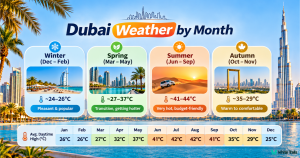
Dubai Weather by Month

Temperatures below are rough daytime highs. Dubai’s climate is simple, really: a long hot stretch, a short mild one, and two transition periods.

Dubai skyline during the best time to visit Dubai with Burj Khalifa.
Dubai cityscape showcasing the ideal season for Dubai holidays.

Winter (December to February)

This is peak Dubai winter travel. Daytime highs sit around the mid-twenties in Celsius, which feels pleasant rather than cold. Nights can dip into the teens, so a light jacket helps if you’re heading to the desert after sunset. Rain is rare, though a short shower or two does turn up, usually in January or February.

December is the busiest month. Hotels fill up around Christmas and New Year, and prices jump. If your dates are fixed, book early. If they aren’t, shift by two weeks and the difference in cost can be surprising.

January and February are slightly quieter, with the same lovely weather. Honestly, February might beat December for value.

Spring (March to May)

You can consider this a transitional season. March is basically the sweet spot. The crowds start to thin, and in April and May the afternoons get properly hot. During that time, except in the mornings and nights, you need to plan your daily outdoor itinerary separately.

During Ramadan, days in Dubai are comparatively slow. Also, some daytime dining will be limited. The nights will be fun and festive, and many travellers love that.

So, it’s basically a different Dubai in Ramadan times, not a worse one.

Summer (June to September)

This might not be a suitable season for you, as temperatures reach the low-to-mid forties with humidity that feels heavier. So people who go in this season try to plan during the nighttime and spend most days inside malls.

Then why do people even plan in summer?

The main reason is budget! Travellers who mostly don’t mind staying indoors and enjoying Dubai can plan for Summer Dubai affordably. Just don’t expect a desert safari at 2 p.m.

Is Dubai worth visiting during summer?

Yes, but because daytime temperatures are high, Dubai’s shopping malls, indoor attractions, luxury hotels, and entertainment venues make it an enjoyable summer destination. So, plan accordingly to avoid the sun.

Autumn (October to November)

October is still warm, often hovering around the mid-thirties, but the heat becomes less punishing as the month goes on. By November, the weather settles into that comfortable range, and the Dubai travel season starts to wake up. Early November is a handy window, since you’ll often catch winter-like conditions before winter prices arrive.

Understanding the Dubai Travel Season

Weather is only half of the planning. The other half is how busy and expensive the city gets.

  • High season runs from late November through February. Expect full hotels, packed attractions, and higher airfares, especially from India around school holidays and the year-end break.
  • Shoulder season covers March, April, October, and early November. Weather is decent, crowds are manageable, and prices are fairer.
  • The low season is roughly May through September. It’s hot, quiet, and cheap.

One thing worth knowing is that the Dubai Shopping Festival usually runs across winter, often from December into January, with sales, fireworks, and live shows. You can check current dates on Visit Dubai, the city’s official tourism site. If shopping is your main goal, that window can be worth the higher hotel costs. If it isn’t, you could easily skip it.

Which Time Suits Which Trip?

Camel riders and a desert campfire at sunset in Dubai
Dubai desert adventure with a 4×4, camel rides and falcon

Different trips want different months, so it helps to start with what you plan to do.

  • Desert safari, dune bashing, camping: November to February. Evenings in the dunes are cool and clear.
  • Beaches and water parks: March to April, and again in October to November. Warm enough to swim, not hot enough to ruin it.
  • Honeymoon: January or February for weather, or summer if you’d rather spend the savings on a villa with a private pool.
  • Family trips with young kids: Winter, mostly. Strollers, heat, and tired children are a hard mix.
  • Budget travel: Late spring or summer, if you accept the heat.

What about first-time visitors who only get one shot at it? If I had to choose, I’d go for the last week of February or the first half of March. The weather is still kind, and the crowds have loosened a bit.

Decide Based on Your Travel Style

Dubai is a place that you can visit throughout the year only if you have a proper plan that matches your travel needs. The season you choose can significantly affect your comfort, activities, and overall travel experience.

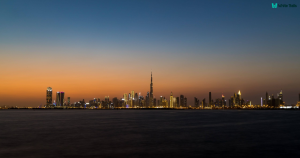
Dubai skyline at dusk with Burj Khalifa and waterfront views
Illuminated Dubai skyline beneath an orange sunset sky
Travel Style Suitable Months Best For Weather 
Family Holiday November to March Sightseeing, beaches, desert safaris and outdoor activities Cooler and more comfortable
Desert Safari November to March Sightseeing, beaches, desert safaris and outdoor activities Cooler and more comfortable
Honeymoon November to February Sightseeing, beaches, desert safaris and outdoor activities Cosy and Comfortable
Beaches November to April Mixed indoor and outdoor itineraries Cosy and comfortable — then transition towards hot season
Budget Travel June to September Shopping, indoor attractions and resort stays Very hot
Luxury Travel October to March Sightseeing and outdoor activities Transition towards Cooler and more comfortable

So, plan smart and visit Dubai in your preferred season!

Practical Tips Before You Go…

A few things catch people out, so it’s worth getting them sorted early.

Wherever you go, you need to respect the local culture. In Dubai, you can always carry beachwear, but that is not all. It is also a good option to carry a light shawl or shirt in your bag. In mosques, souks, and malls, they prefer covered shoulders and knees.

Also, plan around the sun. In warmer months, put outdoor stops at sunrise or after 5 p.m. In winter, you’ve got more flexibility, but midday at the Burj Khalifa observation deck tends to be hazy, so sunset slots are popular and sell out first.

Book the big experiences ahead. Desert safaris, Burj Khalifa tickets, and Dubai Frame slots all fill up in peak season. Booking even a week in advance helps.

In Dubai, do not get fooled by the temperature! When the actual temperature is 32°C, it might feel like 37°C on the coast. So, carry your sunscreen and all preferred products, including a water bottle.

Do check the passport rules for Indians, including visa conditions and entry requirements. Follow the latest data because it may change over time.

While winter is the best option for you in Dubai, it may also come with factors like high prices and tighter availability. Therefore, you need to decide between crowds and heat. Also, the transitional seasons, March to May or September to November, can be a good option.

How many days are enough for Dubai?

A stay of at least 4 to 5 days is ideal for experiencing the city’s major attractions, beaches, shopping districts, and a desert safari. Dubai may fool you in photos with its compact nature. Find your sweet spot before finalising your itinerary.

Plan It With Someone Who Knows the Ground

If you want to avoid juggling flights, hotels, and activities, plan a trip with an expert and let them shape it comfortably for you. Whitetrails offers customised Dubai tour packages planned for your convenience.

No matter the best time to visit Dubai, whether it’s your February honeymoon or a November family trip, we have it all set for you!

Dubai takes a bit of planning, and we have already done it for you. We suggest you decide between November and March to experience the best of Dubai. Contact us, and we’ll take care of everything else, from flights to accommodation.

Singapore Visa for Indians: Requirements, Documents & Application Process

A traveller notices a problem while checking in online: their passport has less than six months left before expiry. The flights are booked, and the hotel can no longer be cancelled. Worse, the visa application hasn’t even been filed. 

Your small oversight now threatens the entire trip.

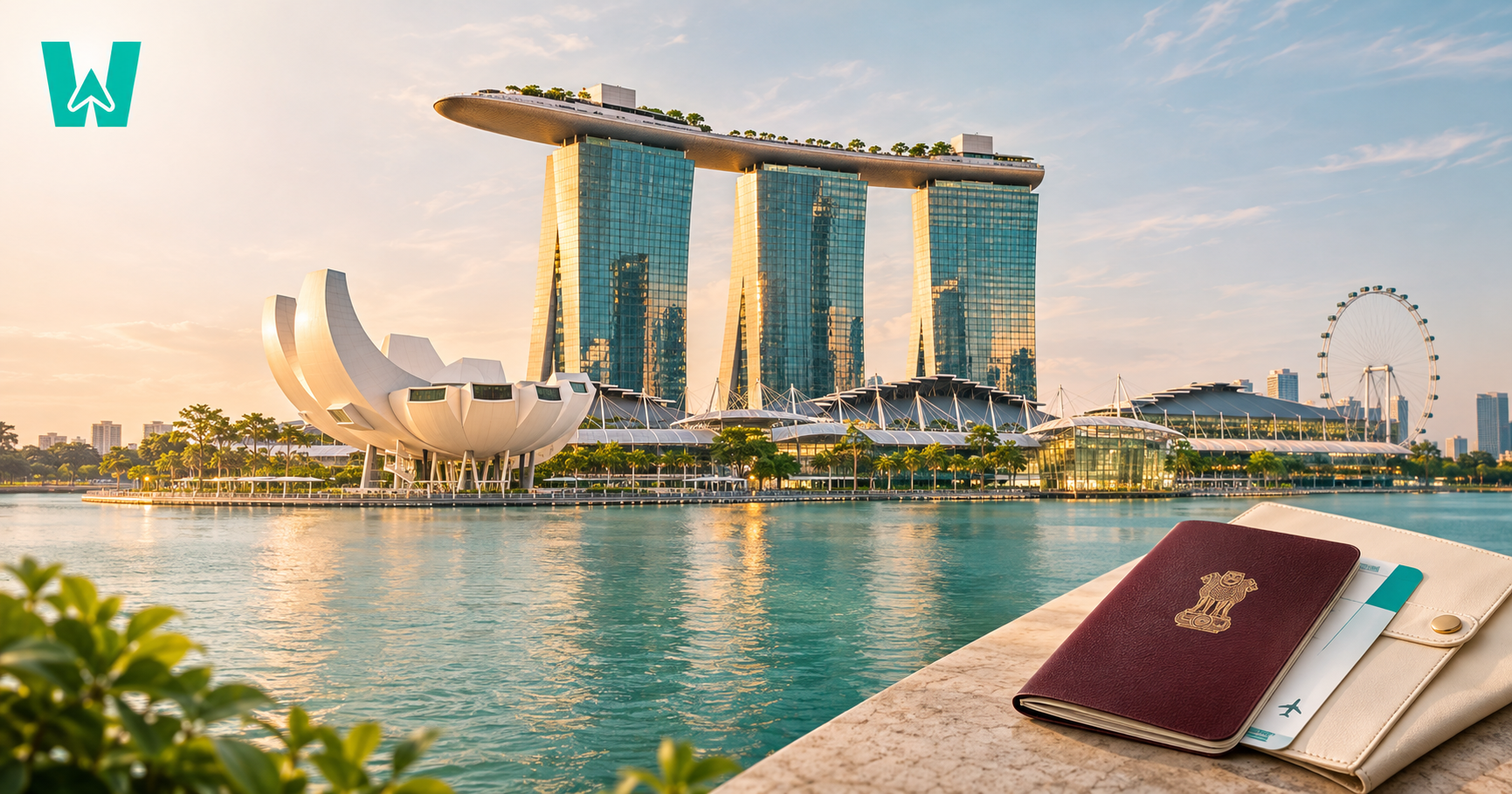
Planning a Singapore visa for Indians should begin before paying for any restricted booking. This Singapore Travel Guide also highlights the visa details travellers should check before departure. Here’s the scenario: Indian citizens with ordinary passports need an entry visa. The file must meet Singapore’s current document and photograph rules; even minor inconsistencies can lead to delays.  

For instance, a passport number typed incorrectly, or a hotel reservation covering only half the visit, are both red flags. Similarly, an old photograph may be enough to hold up your otherwise routine application.

There’s another matter to make a note of: a valid visa lets you travel to Singapore and request entry. But it doesn’t guarantee admission. Nor does it decide how long you may stay. 

Immigration officers make that decision at the checkpoint.

Do Indian Citizens Need a Visa for Singapore?

It is compulsory for all Indian citizens travelling with ordinary Indian passports to secure a visa before entering Singapore. 

Indian diplomatic, official and service passport holders are exempt under the current rules.

Most holiday applications are for social visits. The visa shows the period during which its holder may seek entry and the number of permitted journeys. This doesn’t mean that the visitor gains an automatic right to remain in Singapore until the visa expires.

Suppose a visa remains valid for two months. That doesn’t mean the traveller may stay in Singapore for two months. 

The authorised stay is recorded separately in the electronic Visit Pass. This is issued after arrival. Visitors receive the e-Pass details digitally, which means the email address entered in the SG Arrival Card needs to be correct. 

The SG Arrival Card is a separate travel declaration. It isn’t a replacement for a visa. 

Paying an unofficial website to complete it doesn’t improve your chance of admission. 

White Trails advises you to use Singapore’s official immigration service. Enter the same passport details shown in the visa application.

Singapore Visa Requirements for Indian Applicants

Start with a passport with at least six months of validity on the planned date of entry into Singapore. 

Count from arrival, not from the date on which you submit the application.

Renewal is usually the better option if the passport falls short. Applying first and updating the passport later can create a second round of work. This is because the visa record is tied to the travel document used for the application.

The remaining Singapore visa requirements aren’t difficult, but they need to agree with one another. 

An applicant should have: 

  • A credible reason for visiting
  • An address for the stay
  • Enough money to cover the trip 

Note: Immigration authorities may ask for a confirmed return or onward ticket.

Files will differ from traveller to traveller. For instance, a salaried applicant staying at one hotel may present a compact set of records. A self-employed traveller visiting relatives could need host details or a Letter of Introduction. 

In the end, the information should make sense without the reviewer having to guess.

Singapore Visa Documents You May Need

It is very important to have a clear idea about the documentation you need to have on you before visiting the visa application centre. Your trip plans, Singapore package, and itinerary come later.

We have laid down what you need below:

  • Passport and Biodata Page

Provide a clear copy of the passport biodata page. All characters must remain visible – from the passport number, full name and date of birth to the issue date and expiry date.

Scans taken under poor light can hide digits near the binding. Phone photographs may also introduce glare across the machine-readable area. 

Open the file at full size before sending it to the visa agent. 

Applicants who have recently renewed their passports should ask if there’s a need to submit copies of the old passport or previous visas. Also, don’t combine a booking made under the old passport number with a new passport without correcting the reservation.

  • Completed Form 14A

Form 14A records the applicant’s: 

  • Identity.
  • Contact information.
  • Occupation.
  • Intended travel dates.
  • Singapore address.
  • Purpose of visit.

It also asks about previous immigration and legal matters.

Use the name exactly as it appears in the passport. Indian passports don’t always follow the first-name-and-surname pattern assumed by booking systems. 

Don’t invent a surname or rearrange the name under any circumstances.

Check the passport number twice, then check it once more against the machine-readable line. Letters such as “O” and numbers such as “0” are easy to confuse. Complete the declarations honestly and sign the form where required.

  • Recent Colour Photographs

The Singapore High Commission in New Delhi currently asks for two passport-sized colour photographs. These must be taken within the previous three months. 

Each photograph should measure 35 mm by 45 mm, have no border and show the full face against a plain white background. Shadows behind the head, glare on spectacles, or an unevenly exposed face may make a photograph unsuitable. 

Hair shouldn’t cover the eyes or eyebrows. Spectacle frames mustn’t obscure the eyes.

A studio that handles international visa photographs may already know these prerequisites. It would still be prudent for you to check the print. 

“Passport size” can mean different things at different shops.

  • Flight, Stay and Itinerary Records

Applicants don’t need to purchase an air ticket for the application. Singapore’s High Commission also warns that travellers who purchase tickets before receiving the decision bear the financial risk. 

This holds whether the application fails or the granted visa doesn’t cover the intended dates.

That creates a genuine planning problem. Waiting for approval may raise fares, but buying non-refundable seats too early puts more money at risk. More expensive yet flexible reservations are often a sensible compromise.

If you do submit travel records, make it an easily understandable sequence. 

The arrival date, hotel check-in, hotel check-out and departure date should line up. The itinerary should show any late-night departure clearly to explain any difference.

For a stay with family or friends, provide the correct residential address and host information. These will be requested by the agent.

  • Financial, Employment or Business Records

An agent may ask for: 

  • Bank statements.
  • Salary slips.
  • An employment letter.
  • Business records.

The exact request can depend on the applicant’s profile and the purpose of travel. 

It is also crucial to understand that more paperwork isn’t automatically better. For instance, a bank statement showing ordinary income and spending is good optics. A sudden large deposit with no obvious source isn’t. 

Also, if another person is paying for the trip, identify the sponsor. Include the supporting records requested for that arrangement.

Employment letters should use travel dates that match Form 14A. For self-employed applicants, registration or business evidence may be relevant. 

Students and children may need records connected to a parent or accompanying traveller.

  • Letter of Introduction

Form V39A, the Letter of Introduction for a Visa Application, may be requested on a case-by-case basis. 

For a social visit, the local contact must be a Singapore citizen or a permanent resident aged at least 21. That contact should act for a business registered in Singapore when it’s a business visit.

Not every tourist needs this document. Ask the authorised agent what applies to the specific file.

The Singapore Visa Application Process

Applications in India are submitted through visa agents authorised by the Singapore High Commission. 

The current agent list should be checked before handing over a passport copy. Or, for that matter, making any payment. 

A local contact or approved strategic partner in Singapore may also submit through the relevant online service where permitted.

Here is a practical sequence:

  1. Check passport validity and settle the intended travel dates.
  2. Download the current Form 14A rather than using an old saved copy.
  3. Prepare the photographs and supporting records requested for the applicant’s circumstances.
  4. Compare names, dates and passport numbers across every document.
  5. Submit through an authorised agent and retain the receipt or reference number.
  6. Check the decision through the official status service.
  7. Print or save the approved e-Visa and verify every personal detail.

Applicants are advised to file within 30 days before arrival. Normal processing generally takes three to five working days. This excludes the submission date and weekends, along with public holidays. 

Don’t treat the five-day estimate as a guaranteed deadline. Some applications take longer.

The current visa processing fee is INR 2,100, as of November 2026. It is non-refundable regardless of the result. Authorised agents may charge an extra service fee of INR 1,300. Confirm these amounts against the Singapore High Commission’s visa guidance before paying.

Why Applications Get Delayed or Rejected

Incomplete forms are one common cause. Missing signatures, outdated photographs and unreadable passport copies can also interrupt processing.

Conflicting information is harder to fix. Consider if the occupation given on Form 14A differs from the employer’s letter; the reviewer may need clarification. The same applies when the purpose of travel appears to change in the application or itinerary. 

No travel agent can guarantee approval, regardless of the language used in an advertisement. An agent’s job is to receive and submit an application through an approved channel. Singapore’s immigration authorities decide the outcome.

The first review is worthwhile because there isn’t always a detailed explanation for refusal. 

What to Do After Approval

Read the e-Visa rather than filing it away immediately. Check the name, passport number, validity period and permitted number of journeys. 

Contact the submitting agent before travel if anything is wrong, 

Keep the e-Visa, passport, accommodation record and tickets accessible during the journey. Immigration officers may also ask about the purpose of the visit or the money available for the stay.

Complete the SG Arrival Card within the official submission window. Use the passport connected to the visa. 

If the passport is lost, damaged or replaced after approval, seek instructions before travelling.

Once admitted, check the e-Pass email for the final permitted stay and departure date. Remember that the date printed on the visa isn’t the deadline for leaving Singapore.

Plan the Paperwork Before the Bookings Become Expensive

The application itself is manageable. Problems arise when travellers leave no margin for a new photograph, a passport renewal or an extra document request. 

By then, flight-change charges can cost far more than the visa.

A carefully prepared Singapore visa for Indians application doesn’t need padded bank records or a long appeal to the reviewer. It needs current forms, readable copies and details that agree from one page to the next. 

At White Trails, we ask you to build the trip around those facts and use an authorised submission route. Also, leave enough time as contingency if the file takes longer than the standard estimate.

Singapore Trip Cost from India: Complete Budget Breakdown

When it comes to travelling abroad for Indians, there are a few destinations that always make the list, and Singapore is one of them. Apart from being close to India, it also offers a diverse and memorable experience.

The planning, however, is a different conversation. It always starts with one question: what is the Singapore trip cost from India? And the search for the answer starts with finding a tempting airfare, an attractive hotel deal and ends with Singapore dollar conversions.

While the spectrum is broad, it is also a reminder that you need to plan well to keep the trip in your budget. And Singapore rewards sensible planning because its public transport works well, the street food is accessible, and several memorable sights cost nothing. The expensive parts, however, are usually accommodation and ticketed experiences.

How Much Does a Singapore Trip from India Cost?

First, let’s look at some numbers to set the context of what a Singapore trip costs from India.

For instance, a four-night, five-day trip can cost around ₹85,000 to ₹1,10,000 per person. This is a workable mid-range estimate when two adults share a room. Additionally, this budget covers return flights, visa processing, a decent hotel, meals, public transport and two or three major attractions.

Now, here is a detailed breakdown of the expenses for your reference:

Expense Budget trip Mid-range trip Premium trip
Return flights ₹18,000 to ₹28,000 ₹25,000 to ₹38,000 ₹40,000 to ₹65,000
Visa and processing ₹3,000 to ₹4,000 ₹3,000 to ₹4,000 ₹3,000 to ₹4,000
Stay for four nights, per person ₹12,000 to ₹20,000 ₹22,000 to ₹38,000 ₹50,000 to ₹90,000
Food ₹6,000 to ₹10,000 ₹12,000 to ₹20,000 ₹25,000 to ₹45,000
Local travel ₹2,500 to ₹4,500 ₹5,000 to ₹8,000 ₹12,000 to ₹20,000
Attractions ₹6,000 to ₹12,000 ₹15,000 to ₹25,000 ₹28,000 to ₹45,000
Insurance, SIM and buffer ₹3,000 to ₹6,000 ₹5,000 to ₹8,000 ₹8,000 to ₹12,000
Estimated total ₹50,500 to ₹84,500 ₹87,000 to ₹1,41,000 ₹1,66,000 to ₹2,81,000

Now, you need to remember that the numbers presented here are for reference. They will help you plan better. So, don’t confuse them with fixed quotes from White Trails.

The final Singapore trip cost from India will depend on the following factors:

  • Date of the trip
  • Duration of the stay
  • Number of travellers
  • Choice of accommodation and transpiration
  • Number of attractions
  • Total baggage

Decoding the Singapore Tour Cost Further

With a likely cost of a Singapore trip out of the way, let’s now focus on each element of it and see how things are transpiring:

Return Flight Costs from Indian Cities

The first point that we will look at is the cost of flights. Why? Well, this is probably the first thing you will book, and it’s also the easiest to misread.

Social media also says booking on Wednesday afternoon gets you the best price. While that is true to some extent, this is not the entire picture. Flight prices are dynamic, and if the route or timing is in high demand, you will have to pay more.

For instance, a Singapore flight from Delhi on Friday afternoon can cost around ₹20,000, but the same flight around 10 a.m. can cost about ₹30,000.

Now, there are a few areas that further decrease the cost: 

  • If you book return tickets on the same airline, the total fare may be lower.
  • If you book flights with a stopover, prices are often favourable.
  • If you can avoid weekends, you can sometimes get a good deal.
  • If you can book 8-12 weeks in advance, you can get a better deal.
  • You can try to use a credit card to get a better deal.

Also, compare flight ticket prices from different providers and then decide.

Visa, Insurance and Entry Expenses

As an Indian passport holder, you will need a visa to enter Singapore.

Once you apply for a visa, it usually goes through authorised visa agents. However, the combined government fee and processing charges may vary by jurisdiction and agent. However, setting aside about ₹3,000 to ₹4,000 per traveller for visa processing is usually enough.

The SG Arrival Card is separate from the visa and should be submitted through the official immigration channel within the permitted period before arrival. It doesn’t replace a valid visa.

Travel insurance is also important for your trip to Singapore. It usually costs around ₹800 to ₹2,000 for a short trip, depending on age, cover and declared medical conditions.

A common question is: Can you skip insurance to save money? Well, technically yes. But one missed connecting flight or urgent clinic visit could wipe out the savings, so this is a poor place to squeeze the budget.

Hotel Prices and the Location Trade-off

Accommodation can make or break the Singapore travel budget. And this is applicable for any other international destination that you will visit afterwards.

In Singapore’s case, a no-frills room around Little India, Geylang or Lavender may cost ₹6,000 to ₹10,000 per night. Whereas Mid-range hotels near Bugis, Novena or Clarke Quay often sit around ₹11,000 to ₹18,000. Marina Bay, Orchard Road and Sentosa properties can climb rapidly.

Now the awkward bit: the cheapest room isn’t always the cheapest choice. A remote stay with poor MRT access may mean extra transfers, cab fares, and lost time. We’d usually choose a smaller room near a station over a larger one requiring two transport changes.

Now, if you are travelling with family, then you must check the room’s occupancy rules before finalising. Because rooms in most Singapore hotels are compact, and an extra bed may cost considerably more than expected.

Food and Daily Spending

When it comes to food, Singapore won’t disappoint you. From the flavours to the variety to the price, it has it all.

Hawker centres such as Maxwell Food Centre, Lau Pa Sat and Tekka Centre make it possible to eat well without relying on costly restaurants. Set aside about ₹1,200 to ₹2,000 per person per day for mostly street food, drinks and the occasional café stop.

If you plan to visit restaurants, a daily budget of ₹2,500 to ₹4,000 is often enough. However, restaurant meals, cocktails around Marina Bay, and hotel breakfasts can push the figure higher.

Moreover, vegetarian Indian food is easy enough to find around Little India, although prime-location restaurants won’t necessarily be cheap.

Here, a practical framework could be like: 

  • Having breakfast near the hotel
  • Eating lunch at a hawker centre
  • Choosing one planned restaurant dinner

MRT, Buses and Airport Transfers

Public transport keeps the Singapore holiday cost under control. The MRT and bus network covers most tourist areas, including connections from Changi Airport. That’s why a daily allowance of ₹500 to ₹900 per person works for regular public transport use, with some room for short detours.

Taxis and app-based cars are also available, but they are expensive. So, ideally, you can keep them for late-night activity or when travelling with small children. High demand, airport surcharges and several short rides can turn a ₹4,000 transport plan into ₹10,000 before anyone notices.

For a couple or family, compare a cab from the airport with the combined train fare and walking involved. Sometimes paying a little more is the sensible call, especially after an overnight flight.

Attraction Tickets Can Reshape the Budget

Now, let’s talk about attractions, which will also be a significant part of your Singapore tour cost. The most popular destinations here include:

  • Universal Studios Singapore.
  • Gardens by the Bay conservatories.
  • The Singapore Zoo.
  • Night Safari.
  • Sentosa Island activities.

Depending on the attractions you go for, the total cost of the trip will change. That’s why, choose two or three paid highlights, then build the remaining time around free or low-cost experiences:

  • Walk through the outdoor sections of Gardens by the Bay.
  • Spend an evening along Marina Bay and watch the light displays.
  • Explore Chinatown, Kampong Glam and Little India.
  • Visit the Singapore Botanic Gardens.
  • Take a neighbourhood food walk without a paid guide.

A bundled Singapore holiday package can make sense when multiple attraction tickets, transfers and hotel nights are already on your list. The trade-off is less flexibility. But do not forget to check cancellation terms and daily timings rather than comparing only the headline price.

A Realistic Five-Day Budget for Two Adults

Suppose two adults fly from Delhi to Singapore. They stay for four nights in a mid-range hotel near an MRT station, eat at a mix of hawker centres and casual restaurants, and visit Universal Studios Singapore plus the Night Safari. Based on current 2026 pricing ranges, a realistic budget would look like this:

  • Return flights from Delhi for two: ₹60,000
  • Visa and authorised agent charges: ₹6,800
  • Mid-range hotel for four nights: ₹60,000
  • Food and drinks for five days: ₹30,000
  • MRT, buses and two cab rides: ₹9,000
  • Universal Studios Singapore and Night Safari tickets: ₹25,000
  • Travel insurance and eSIMs: ₹5,000
  • Contingency fund: ₹15,000

So, the estimated Singapore trip package from India comes to roughly ₹2,10,800 for two adults, or about ₹1,05,400 per person.

Now, shopping isn’t included in this estimate, and neither is a surprise rooftop dinner, which has a habit of appearing once the skyline does.

Plan the Number Before You Plan the Photos

The Singapore trip cost from India becomes manageable once you treat flights, hotel nights, and paid attractions as one decision rather than separate bargains. For most travellers, ₹85,000 to ₹1,10,000 per person is a credible working range for five days with reasonable comfort.

But as the experts always say, maintain a 10% buffer for unannounced incidents. Also, check what every booking excludes and convert Singapore dollar prices before confirming the day’s plan. This small discipline matters as it leaves more room for the experiences you’ll remember and fewer unpleasant calculations after you return.

How Many Days Are Enough for a Singapore Trip?

Families mostly consider a Singapore trip a weekend trip they want to cover in three nights. If this is usual for you, then let us inform you that Singapore is not a tiny city like Kolkata or Bengaluru that you can cover in three nights.

Day one easily goes with check-in, a long lunch, and tiredness. On the next day, you are fresh and want to visit everything. That way, you reach Sentosa, which eats up most of your afternoon, and you don’t have much time left to go to two more places.

On day 3, with the tension of packing, you cover nearby places to your hotel and return happy. Happy with a list of things to do and visit?

Well, that is a common story for people who assume they can cover Singapore easily.

So, how Many Days for Singapore?

When you pay a healthy price for your trip abroad, why risk your happiness? It’s time to understand the whole scenario and plan for at least four to five days on your first visit to Singapore from India.

Why Singapore Fools You on Size

It might seem compact because of its geographic location and planned layout. The MRT reaches most places you’d want to go, and a cab across town rarely takes long. Planning feels easy because of that.

But the trouble you will feel with this city-state is the density. Travel time is short, but the queues aren’t. One small island holds a zoo, a night safari, a river wildlife park, a theme park island, hawker centers, several distinct cultural districts, and a nightly light show. Each of these swallows half a day, sometimes more.

Moreover, there’s the heat. Walking at noon in Singapore isn’t like a winter afternoon in Bengaluru, Punjab, Kolkata, or Delhi. Most people need a midday break in an air-conditioned mall or hotel room, and that quietly removes a couple of hours from every day.

Two or Three Days: A Taste, Not a Trip

A two- or three-day Singapore trip duration gets you the postcard. Marina Bay, the Merlion, Gardens by the Bay, perhaps a quick run to Sentosa. It’s fine for a stopover or a work trip with a little slack.

You’ll be choosing constantly, though. Universal Studios alone can take a full day, and if you add the Night Safari, your third day is gone. With older parents or small kids, the pace gets uncomfortable fast.

My view? Three days only works if you’ve travelled in similar cities before and you just want a sample.

The Sweet Spot: Singapore 4-Days Itinerary – Singapore 5-Days Itinerary

This is where the trip stops feeling like a checklist. A rough shape could look like this.

  • Day one. Arrive, settle in, and take an evening walk around Marina Bay for the light show.
  • Day two. Sentosa and Universal Studios if theme parks are your thing. If they aren’t, spend the day at Gardens by the Bay and the Botanic Gardens.
  • Day three. Chinatown, Little India and Kampong Glam. Eat a lot.
  • Day four. The Mandai area, which holds the zoo, River Wonders and the Night Safari. Pick one or two, since doing all of them is a slog.
  • Day five is for Orchard Road, a slow breakfast, then the airport. Jewel Changi is worth an hour by itself.

Five days leaves a buffer. A thunderstorm can wipe out an outdoor afternoon with almost no warning, and a spare half-day means you simply shuffle things around. Many travellers find a ready-made Singapore tour package handy at this length, because the transfers and tickets are already sorted and you’re not queuing at counters.

What About Seven Days or More?

Does a full week make sense? Sometimes.

If you like slow mornings, long café stops, and wandering neighbourhoods without a plan, seven days is lovely. You can add Pulau Ubin for cycling, a proper museum day at the National Gallery, or a few evenings doing nothing much.

Still, there’s a fair case for doing the opposite. A week in Singapore alone can start to feel repetitive, and it gets pricey. Hotels aren’t cheap, and even with hawker meals keeping the damage down, the bill adds up. Many people get better value from four days in Singapore and three in Malaysia. Kuala Lumpur is a short flight away. Check current entry and border rules before you plan anything by land, since those change.

Match the Days to the Traveller

Not everyone needs the same answer to how many days for Singapore. A few patterns come up again and again.

  • Families with young kids should add a day. Naps, meltdowns, and slow-moving lines are real, and they don’t care about your Singapore itinerary.
  • Couples on a honeymoon do well with four or five days, keeping an evening or two completely free. Don’t schedule every hour.
  • Friends traveling light, especially if food and nightlife matter more than rides, can manage three or four.
  • Senior travellers are better off with five or six, one rest day included, and fewer stops per day.
  • Someone tacking leisure onto a business trip? Add a weekend, so two extra days.

The plan needs to be curated based on your preferences and the kind of people going with you.

Pace Matters More Than the Number

Two things decide whether a trip feels rushed. One is how many big attractions you cram into a day. The other is how much empty time you’ve left.

Try one major attraction and one lighter stop per day. Universal Studios counts as major. A hawker centre dinner counts as light. Stack two majors on the same day, and you’ll be dragging by 3 pm.

Arrival is the other trap. Flights from India often land in the morning or late at night, so your first day is partly gone either way, and the last day is mostly spent getting to the airport. Count both as half days. A “five-day” trip then holds about four days of real sightseeing, which surprises people.

Season, Weather and Budget

When planning your Singapore Trip Cost from India, consider the season, accommodation, flights, and sightseeing expenses. Singapore is warm all year, and rain can show up in any month. School holidays and the year-end period get crowded, and prices climb with them. A shorter stay can make sense then, simply because each extra night costs more.

Every added night brings a hotel bill, meals, transport and tickets. It’s usually cheaper to add a day to a flight you’ve already booked than to make a second trip later, but it isn’t free. Ask what the extra day is actually buying you.

The official Singapore Tourism Board site is a decent place to check opening days and seasonal events before you lock dates.

A Quick Way to Decide

Grab a pen and try this.

  1. List your must-dos. Five at most.
  2. Give each a half day or a full day.
  3. Add one free half-day for rain or rest.
  4. Count arrival and departure days as half days.

Add it up. That’s your number, and it’s usually closer to four or five than to three.

So, How Many Days for Singapore?

We would recommend five days! Even four works well if you’re extremely organized and don’t mind a near-hectic schedule. Here, we must inform you that three days will be a sampler, and seven is a luxury that pays off mostly for slow travellers or people pairing Singapore with another country.

Risks are there from both ends. You book a too-short trip, and you pay extra money for flights and all sorts of rush trip essentials, including unplanned expenses. On the other hand, with a too-long trip, you are already paying extra for each day counted. Neither is a disaster, but both are avoidable with ten minutes of honest planning.

So be realistic with your Wishlist and what your family actually wants to do. Based on your type and preferences, you can plan accordingly. A trip with breathing space is almost always the one people remember well. If you want a curated plan with zero headache, visit our website or contact us with your queries.

Best International Destinations to Visit from India in 2026

Planning an international holiday in 2026? For Indian travellers, international travel has become more accessible than ever, with more direct flights, diverse holiday packages and destinations suited to every kind of traveller. Whether you are planning a romantic honeymoon, a family vacation, an adventure-filled trip or a luxury escape, there are plenty of exciting destinations to explore.

Here are some of the best international destinations to visit from India in 2026.

1. Vietnam – Culture, Beaches and Adventure

Vietnam continues to be a popular choice among Indian travellers, thanks to its beautiful landscapes, fascinating culture and relatively affordable travel experience. From the bustling streets of Ho Chi Minh City to the peaceful beauty of Halong Bay and the beaches of Da Nang, Vietnam offers something for everyone.

For couples and families looking for a mix of sightseeing, food and relaxation, Vietnam can be an excellent choice.

2. Dubai – Luxury, Shopping and Experiences

Dubai is a favourite among Indian travellers for good reason. It combines luxury, entertainment, shopping and unforgettable experiences in one destination. Visitors can explore the Burj Khalifa, enjoy a desert safari, shop at world-class malls or simply relax at luxurious resorts.

Dubai is also a convenient option for a short international break, making it ideal for families, couples and even first-time international travellers.

3. Maldives – The Perfect Island Escape

If your idea of a holiday involves turquoise waters, private villas and peaceful beaches, the Maldives deserves a place on your list. It is especially popular among honeymooners and couples looking for a romantic getaway.

From relaxing in an overwater villa to enjoying water sports and sunset cruises, the Maldives offers the perfect combination of privacy and luxury.

4. Japan – Tradition Meets Modernity

Japan is an excellent destination for travellers who want a completely different cultural experience. Tokyo’s modern cityscape, Kyoto’s traditional temples and Osaka’s vibrant food scene make Japan a fascinating destination.

If you are planning a Japan trip in 2026, consider spending enough time exploring multiple cities rather than rushing through the highlights.

5. Mauritius – Beaches and Beyond

Mauritius is more than just a beach destination. Its beautiful coastline, lush landscapes, cultural diversity and exciting activities make it a wonderful choice for couples and families.

Travellers can enjoy water activities, explore local markets, visit scenic viewpoints or simply spend a relaxing day by the ocean.

6. Singapore – A Family-Friendly Favourite

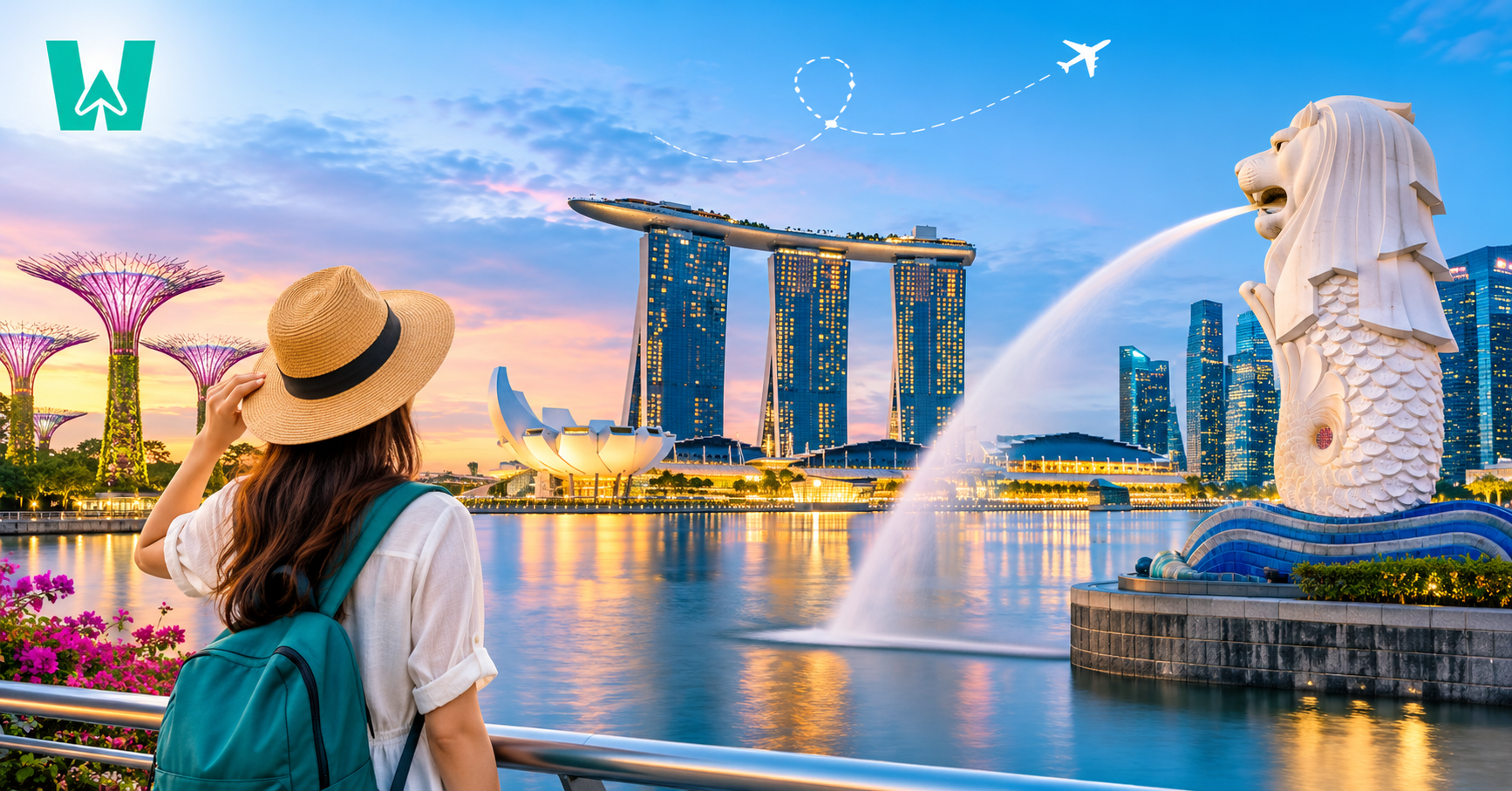
Singapore is one of the easiest international destinations for Indian families to enjoy. With attractions such as Marina Bay, Gardens by the Bay, Sentosa and Universal Studios, there is plenty to keep both children and adults entertained.

Its clean surroundings, efficient transport and wide range of experiences make it a comfortable choice for first-time international travellers.

Plan Your 2026 International Holiday with White Trails

Choosing the right destination is only the first step. Flights, hotels, transfers, sightseeing, visas and experiences all need careful planning to make your holiday smooth and enjoyable.

With a customised travel plan, you can design your holiday around your interests, budget and preferred travel style instead of following a fixed itinerary.

Whether you are dreaming of a romantic Maldives escape, a cultural journey through Japan or an exciting family holiday in Dubai, White Trails can help you plan an international holiday that suits you.

So, where will you travel in 2026? Start planning early, choose your destination wisely and get ready to create memories that last a lifetime.

Customised International Tour Packages: Are They Worth It?

Planning an international holiday is exciting, but putting together the perfect trip can sometimes feel like a lot of work. From choosing flights and hotels to deciding what to see, where to eat and how much time to spend in each place, there are many things to consider.

This is where customised international tour packages come into the picture. But are they really worth choosing over standard holiday packages? For many Indian travellers, the answer can be yes.

What Are Customised International Tour Packages?

A customised tour package is designed around your travel preferences instead of following a fixed itinerary. You can choose your destination, hotel category, activities, sightseeing options, travel dates and even the pace of your holiday.

For example, a couple travelling to Europe may prefer romantic experiences and luxury hotels, while a family may want child-friendly activities and comfortable transfers. A customised package allows the itinerary to be planned accordingly.

1. Travel According to Your Interests

One of the biggest advantages of a customised package is flexibility. You do not have to spend your holiday visiting places simply because they are included in a standard package.

Love food? Your itinerary can include local culinary experiences. Interested in history and culture? More museums, heritage sites and guided tours can be added. Prefer a relaxed holiday? You can have more free time instead of rushing from one attraction to another.

2. Better Use of Your Time

Nobody wants to spend a large part of their international holiday travelling between attractions or waiting for a large group to get ready.

A customised itinerary can be planned according to your preferred pace. You can decide how many destinations you want to cover and how much time you want to spend at each location.

This can be especially useful for short international trips where every day matters.

3. Suitable for Different Budgets

Customisation does not necessarily mean spending more. Instead, it allows you to decide where you want to spend and where you would prefer to save.

For instance, you might choose a luxury hotel for a special occasion but opt for comfortable premium accommodation at other locations. Similarly, you can select experiences that genuinely interest you instead of paying for activities you may not use.

4. More Convenience and Support

International travel involves several moving parts, including flights, accommodation, transfers, sightseeing and travel documentation.

Working with an experienced travel company can make the planning process much easier. Having professional support can also be useful when plans change or unexpected situations arise during the trip.

5. Ideal for Special Occasions

Customised packages can be particularly valuable for honeymoons, anniversaries, birthdays, family celebrations and milestone trips.

Instead of following a standard itinerary, you can create experiences around the occasion. A private dinner, special hotel stay, scenic excursion or unique local experience can make the holiday more memorable.

So, Are Customised Packages Worth It?

For travellers who value flexibility, convenience and personalised experiences, customised international tour packages can be a worthwhile option. They allow you to build a holiday around your preferences rather than adjusting your plans to fit a fixed itinerary.

At White Trails, the focus is on creating travel experiences around the traveller. Whether you are planning a romantic honeymoon, family holiday, luxury escape or corporate trip, a customised itinerary can help turn your travel plans into a more personal experience.

Because ultimately, the best holiday is not simply about visiting a destination. It is about experiencing it your way.

Call Now Enquiry Now